Showing posts with label World War II. Show all posts

Wednesday, December 07, 2011

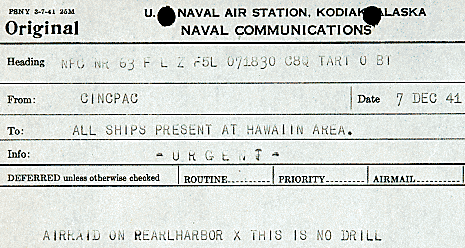
"AIR RAID ON PEARL HARBOR X THIS IS NO DRILL"


Another bright, beautiful Hawaiian morning; it was also Sunday, so everything was even more relaxed than usual. One could hardly be farther from the winter snows back home.


Granted, things were not as blissfully peaceful as they appeared; war was raging in Europe, and some felt the U.S. couldn't stay on the sidelines much longer. Britain was surviving, but the Soviets were reeling, the Nazi blitzkreig driving them ever back. And everything else in Europe, save neutral Switzerland and Sweden, lay under Axis hegemony.


The Pacific was deceptive in its quiesence as well; in China, Imperial Japanese troops continued their atrocity-laden campaign. The U.S. sanctions against them were appearing to sting, and American forces had fallen back from China to the Philippines in case Japanese words turned to actions, and in the fall American forces had increased their readiness... only to wane as the months dragged on. Now the brass worried more about sabotage and not provoking any trouble.


But as of the 6th, the diplomats were still talking, so nothing to worry about, right? As long as they're talking there won't be any fighting, regardless of what those paranoid ninnies in the signals intelligence section say.


Those would be just a few of the illusions shattered that Sunday morning, 70 years ago today.


Tuesday, August 09, 2011

Have We Forsaken Them?

I commend to you this remembrance by Robert Morrison of the Churchill-Roosevelt summit of 1941.

What I wish to leave with you are these closing lines:
This 70th anniversary of the first summit comes just as the U.S. Air Force has backed down ignominiously when challenged by a small, militant group of atheizers. For 20 years, Air Force chaplains have been offering training to those who might be called upon to launch nuclear missiles in the event of a Doomsday scenario. In the course, the Air Force chaplains dared to invoke biblical imagery and offer quotes from Scripture.

Britain’s normally conservative Daily Telegraph hooted at the now-banned course, dubbing it “Jesus Loves Nukes.” Banned as well is anything taught by Augustine of Hippo. His philosophy served for 1,600 years as the basis for just-war doctrine. It is to Augustine we looked to know why the Holocaust was wrong, why the builders of the Gulag were an evil empire. In place of Augustine, we will be directed to the U.N.’s Human Rights Council, where slaughterers of innocents outvote the craven representatives of once-civilized states.

They were the kind of nations whose chosen leaders met at the first summit. Would Franklin Roosevelt and Winston Churchill recognize the world their successors are making? Have we forsaken them and all they did for our freedom? Are we yet men of strength and courage?
How can that world seem so much farther than seventy years away? Oh, the false gods we have built for ourselves...

And they seem to be demanding their reckoning.

Friday, December 17, 2010

Panzers in the Mist

Dec. 16th, 1944, started out bad and got worse, as the the Germans launched their operation "Wacht Am Rhein" ("Watch on the Rhine").


German panzer in advance, from captured German film. (US National Archives.)
Picture (and title of post) shamelessly stolen from John at Castle Argghhh!!!


The cream of the surviving Wehrmacht erupted out of the hills and forests of the Ardennes, objective Antwerp and a complete rupture of the Allied lines. It was a move born of desperation; in Field Marshall Model's terms, it was their "last chance to conclude the war favorably."

And it almost worked.

Throwing a massive weight of excellent German armor against an unaware and unready American line, the ensuing weeks of battle decided the fate of Germany.

We know now how it ended, but Christmas 1944 the fate of the war in Europe was still in question, and the certainty of the Allied successes in the summer of 1944 were suddenly very far away.

Instead, all they had was chaos and confusion - and the American soldier showed a tenacity that few knew they had. Hugh M. Cole tells what little of the story is known in his operational history, The Ardennes: Battle of the Bulge:

On the morning of 16 December General Middleton's VIII Corps had a formal corps reserve consisting of one armored combat command and four engineer combat battalions. In dire circumstances Middleton might count on three additional engineer combat battalions which, under First Army command, were engaged as the 1128th Engineer Group in direct support of the normal engineer operations on foot in the VIII Corps area. In exceptionally adverse circumstances, that is under conditions then so remote as to be hardly worth a thought, the VIII Corps would have a last combat residue-poorly armed and ill-trained for combat-made up of rear echelon headquarters, supply, and technical service troops, plus the increment of stragglers who might, in the course of battle, stray back from the front lines. General Middleton would be called upon to use all of these "reserves." Their total effect in the fight to delay the German forces hammering through the VIII Corps center would be extremely important but at the same time generally incalculable, nor would many of these troops enter the pages of history.

A handful of ordnance mechanics manning a Sherman tank fresh from the repair shop are seen at a bridge. By their mere presence they check an enemy column long enough for the bridge to be demolished. The tank and its crew disappear. They have affected the course of the Ardennes battle, even though minutely, but history does not record from whence they came or whither they went. A signal officer checking his wire along a byroad encounters a German column; he wheels his jeep and races back to alert a section of tank destroyers standing at a crossroad. Both he and the gunners are and remain anonymous. Yet the tank destroyers with a few shots rob the enemy of precious minutes, even hours. A platoon of engineers appears in one terse sentence of a German commander's report. They have fought bravely, says the foe, and forced him to waste a couple of hours in deployment and maneuver. In this brief emergence from the fog of war the engineer platoon makes its bid for recognition in history. That is all.

These unknown men would decide the fate of Europe. All of the blood, sweat, and tears that had been expended since June 6, 1944, depended on whether or not these unknowns held. Whether or not these few could buy enough time for Allied reserves to be brought up, divisions rallied, and the weather to clear so Allied air support could enter the fray.

We know now how this story ends; of the heroic struggle of the green US 99th Division; of the stand of the 7th Armored at St. Vith; of the siege at Bastogne the made a legend of the 101st Airborne; and the ultimate counteroffensive that transformed a German victory into the Wehrmacht's undoing.

But for a few days in December 1944, history hinged on the actions of a few cold, tired, and scared G.I.'s, men whose names we would never even know.

A small group of stragglers suddenly become tired of what seems to be eternally retreating. Miles back they ceased to be part of an organized combat formation, and recorded history, at that point, lost them. The sound of firing is heard for fifteen minutes, an hour, coming from a patch of woods, a tiny village, the opposite side of a hill. The enemy has been delayed; the enemy resumes the march westward. Weeks later a graves registration team uncovers mute evidence of a last-ditch stand at woods, village, or hill.

Tuesday, December 07, 2010

"Air Raid, Pearl Harbor. This is no drill!"


pearl-harbor-2 
 
On a bright Hawaiian morning, war came to the United States. In a matter of hours, the core of the American Pacific Fleet was destroyed, American air power in the Pacific crippled, and American forces were under attack not only in Hawaii, but on Wake Island, Guam, Midway, and the Phillipines.

The men that survived those battles and served as constant reminders are fading quickly away, as time exacts its price. The lessons still hold, even if we forget them.

The cost of relearning those lessons is so very high.

pearl harbor poster

Friday, June 18, 2010

Their Finest Hour

Defeated in Belgium and France, its allies subsumed beneath Nazi occupation, and facing the threat of invasion, Britain on June 18th, 1940, braced for the battle to come.


I spoke the other day of the colossal military disaster which occurred when the French High Command failed to withdraw the northern Armies from Belgium at the moment when they knew that the French front was decisively broken at Sedan and on the Meuse. This delay entailed the loss of fifteen or sixteen French divisions and threw out of action for the critical period the whole of the British Expeditionary Force. Our Army and 120,000 French troops were indeed rescued by the British Navy from Dunkirk but only with the loss of their cannon, vehicles and modern equipment. This loss inevitably took some weeks to repair, and in the first two of those weeks the battle in France has been lost. When we consider the heroic resistance made by the French Army against heavy odds in this battle, the enormous losses inflicted upon the enemy and the evident exhaustion of the enemy, it may well be the thought that these 25 divisions of the best-trained and best-equipped troops might have turned the scale. However, General Weygand had to fight without them. Only three British divisions or their equivalent were able to stand in the line with their French comrades. They have suffered severely, but they have fought well. We sent every man we could to France as fast as we could re-equip and transport their formations.

I am not reciting these facts for the purpose of recrimination. That I judge to be utterly futile and even harmful. We cannot afford it. I recite them in order to explain why it was we did not have, as we could have had, between twelve and fourteen British divisions fighting in the line in this great battle instead of only three. Now I put all this aside. I put it on the shelf, from which the historians, when they have time, will select their documents to tell their stories. We have to think of the future and not of the past. This also applies in a small way to our own affairs at home. There are many who would hold an inquest in the House of Commons on the conduct of the Governments-and of Parliaments, for they are in it, too-during the years which led up to this catastrophe. They seek to indict those who were responsible for the guidance of our affairs. This also would be a foolish and pernicious process. There are too many in it. Let each man search his conscience and search his speeches. I frequently search mine.

Of this I am quite sure, that if we open a quarrel between the past and the present, we shall find that we have lost the future. Therefore, I cannot accept the drawing of any distinctions between Members of the present Government. It was formed at a moment of crisis in order to unite all the Parties and all sections of opinion. It has received the almost unanimous support of both Houses of Parliament. Its Members are going to stand together, and, subject to the authority of the House of Commons, we are going to govern the country and fight the war. It is absolutely necessary at a time like this that every Minister who tries each day to do his duty shall be respected; and their subordinates must know that their chiefs are not threatened men, men who are here today and gone tomorrow, but that their directions must be punctually and faithfully obeyed. Without this concentrated power we cannot face what lies before us. I should not think it would be very advantageous for the House to prolong this Debate this afternoon under conditions of public stress. Many facts are not clear that will be clear in a short time. We are to have a secret Session on Thursday, and I should think that would be a better opportunity for the many earnest expressions of opinion which Members will desire to make and for the House to discuss vital matters without having everything read the next morning by our dangerous foes.

The disastrous military events which have happened during the past fortnight have not come to me with any sense of surprise. Indeed, I indicated a fortnight ago as clearly as I could to the House that the worst possibilities were open; and I made it perfectly clear then that whatever happened in France would make no difference to the resolve of Britain and the British Empire to fight on, 'if necessary for years, if necessary alone." During the last few days we have successfully brought off the great majority of the troops we had on the line of communication in France; and seven-eighths of the troops we have sent to France since the beginning of the war-that is to say, about 350,000 out of 400,000 men-are safely back in this country. Others are still fighting with the French, and fighting with considerable success in their local encounters against the enemy. We have also brought back a great mass of stores, rifles and munitions of all kinds which had been accumulated in France during the last nine months.

We have, therefore, in this Island today a very large and powerful military force. This force comprises all our best-trained and our finest troops, including scores of thousands of those who have already measured their quality against the Germans and found themselves at no disadvantage. We have under arms at the present time in this Island over a million and a quarter men. Behind these we have the Local Defense Volunteers, numbering half a million, only a portion of whom, however, are yet armed with rifles or other firearms. We have incorporated into our Defense Forces every man for whom we have a weapon. We expect very large additions to our weapons in the near future, and in preparation for this we intend forthwith to call up, drill and train further large numbers. Those who are not called up, or else are employed during the vast business of munitions production in all its branches-and their ramifications are innumerable-will serve their country best by remaining at their ordinary work until they receive their summons. We have also over here Dominions armies. The Canadians had actually landed in France, but have now been safely withdrawn, much disappointed, but in perfect order, with all their artillery and equipment. And these very high-class forces from the Dominions will now take part in the defense of the Mother Country.

Lest the account which I have given of these large forces should raise the question: Why did they not take part in the great battle in France? I must make it clear that, apart from the divisions training and organizing at home, only 12 divisions were equipped to fight upon a scale which justified their being sent abroad. And this was fully up to the number which the French had been led to expect would be available in France at the ninth month of the war. The rest of our forces at home have a fighting value for home defense which will, of course, steadily increase every week that passes. Thus, the invasion of Great Britain would at this time require the transportation across the sea of hostile armies on a very large scale, and after they had been so transported they would have to be continually maintained with all the masses of munitions and supplies which are required for continuous battle-as continuous battle it will surely be.

Here is where we come to the Navy-and after all, we have a Navy. Some people seem to forget that we have a Navy. We must remind them. For the last thirty years I have been concerned in discussions about the possibilities of oversea invasion, and I took the responsibility on behalf of the Admiralty, at the beginning of the last war, of allowing all regular troops to be sent out of the country. That was a very serious step to take, because our Territorials had only just been called up and were quite untrained. Therefore, this Island was for several months particularly denuded of fighting troops. The Admiralty had confidence at that time in their ability to prevent a mass invasion even though at that time the Germans had a magnificent battle fleet in the proportion of 10 to 16, even though they were capable of fighting a general engagement every day and any day, whereas now they have only a couple of heavy ships worth speaking of-the Scharnhorst and the Gneisenau. We are also told that the Italian Navy is to come out and gain sea superiority in these waters. If they seriously intend it, I shall only say that we shall be delighted to offer Signor Mussolini a free and safeguarded passage through the Strait of Gibraltar in order that he may play the part to which he aspires. There is a general curiosity in the British Fleet to find out whether the Italians are up to the level they were at in the last war or whether they have fallen off at all.

Therefore, it seems to me that as far as sea-borne invasion on a great scale is concerned, we are far more capable of meeting it today than we were at many periods in the last war and during the early months of this war, before our other troops were trained, and while the B.E.F. had proceeded abroad. Now, the Navy have never pretended to be able to prevent raids by bodies of 5,000 or 10,000 men flung suddenly across and thrown ashore at several points on the coast some dark night or foggy morning. The efficacy of sea power, especially under modern conditions, depends upon the invading force being of large size; It has to be of large size, in view of our military strength, to be of any use. If it is of large size, then the Navy have something they can find and meet and, as it were, bite on. Now, we must remember that even five divisions, however lightly equipped, would require 200 to 250 ships, and with modern air reconnaissance and photography it would not be easy to collect such an armada, marshal it, and conduct it across the sea without any powerful naval forces to escort it; and there would be very great possibilities, to put it mildly, that this armada would be intercepted long before it reached the coast, and all the men drowned in the sea or, at the worst blown to pieces with their equipment while they were trying to land. We also have a great system of minefields, recently strongly reinforced, through which we alone know the channels. If the enemy tries to sweep passages through these minefields, it will be the task of the Navy to destroy the mine-sweepers and any other forces employed to protect them. There should be no difficulty in this, owing to our great superiority at sea.

Those are the regular, well-tested, well-proved arguments on which we have relied during many years in peace and war. But the question is whether there are any new methods by which those solid assurances can be circumvented. Odd as it may seem, some attention has been given to this by the Admiralty, whose prime duty and responsibility is to destroy any large sea-borne expedition before it reaches, or at the moment when it reaches, these shores. It would not be a good thing for me to go into details of this. It might suggest ideas to other people which they have not thought of, and they would not be likely to give us any of their ideas in exchange. All I will say is that untiring vigilance and mind-searching must be devoted to the subject, because the enemy is crafty and cunning and full of novel treacheries and stratagems. The House may be assured that the utmost ingenuity is being displayed and imagination is being evoked from large numbers of competent officers, well-trained in tactics and thoroughly up to date, to measure and counterwork novel possibilities. Untiring vigilance and untiring searching of the mind is being, and must be, devoted to the subject, because, remember, the enemy is crafty and there is no dirty trick he will not do.

Some people will ask why, then, was it that the British Navy was not able to prevent the movement of a large army from Germany into Norway across the Skagerrak? But the conditions in the Channel and in the North Sea are in no way like those which prevail in the Skagerrak. In the Skagerrak, because of the distance, we could give no air support to our surface ships, and consequently, lying as we did close to the enemy's main air power, we were compelled to use only our submarines. We could not enforce the decisive blockade or interruption which is possible from surface vessels. Our submarines took a heavy toll but could not, by themselves, prevent the invasion of Norway. In the Channel and in the North Sea, on the other hand, our superior naval surface forces, aided by our submarines, will operate with close and effective air assistance.

This brings me, naturally, to the great question of invasion from the air, and of the impending struggle between the British and German Air Forces. It seems quite clear that no invasion on a scale beyond the capacity of our land forces to crush speedily is likely to take place from the air until our Air Force has been definitely overpowered. In the meantime, there may be raids by parachute troops and attempted descents of airborne soldiers. We should be able to give those gentry a warm reception both in the air and on the ground, if they reach it in any condition to continue the dispute. But the great question is: Can we break Hitler's air weapon? Now, of course, it is a very great pity that we have not got an Air Force at least equal to that of the most powerful enemy within striking distance of these shores. But we have a very powerful Air Force which has proved itself far superior in quality, both in men and in many types of machine, to what we have met so far in the numerous and fierce air battles which have been fought with the Germans. In France, where we were at a considerable disadvantage and lost many machines on the ground when they were standing round the aerodromes, we were accustomed to inflict in the air losses of as much as two and two-and-a-half to one. In the fighting over Dunkirk, which was a sort of no-man's-land, we undoubtedly beat the German Air Force, and gained the mastery of the local air, inflicting here a loss of three or four to one day after day. Anyone who looks at the photographs which were published a week or so ago of the re-embarkation, showing the masses of troops assembled on the beach and forming an ideal target for hours at a time, must realize that this re-embarkation would not have been possible unless the enemy had resigned all hope of recovering air superiority at that time and at that place.

In the defense of this Island the advantages to the defenders will be much greater than they were in the fighting around Dunkirk. We hope to improve on the rate of three or four to one which was realized at Dunkirk; and in addition all our injured machines and their crews which get down safely-and, surprisingly, a very great many injured machines and men do get down safely in modern air fighting-all of these will fall, in an attack upon these Islands, on friendly. soil and live to fight another day; whereas all the injured enemy machines and their complements will be total losses as far as the war is concerned.

During the great battle in France, we gave very powerful and continuous aid to. the French Army, both by fighters and bombers; but in spite of every kind of pressure we never would allow the entire metropolitan fighter strength of the Air Force to be consumed. This decision was painful, but it was also right, because the fortunes of the battle in France could not have been decisively affected even if we had thrown in our entire fighter force. That battle was lost by the unfortunate strategical opening, by the extraordinary and unforseen power of the armored columns, and by the great preponderance of the German Army in numbers. Our fighter Air Force might easily have been exhausted as a mere accident in that great struggle, and then we should have found ourselves at the present time in a very serious plight. But as it is, I am happy to inform the House that our fighter strength is stronger at the present time relatively to the Germans, who have suffered terrible losses, than it has ever been; and consequently we believe ourselves possessed of the capacity to continue the war in the air under better conditions than we have ever experienced before. I look forward confidently to the exploits of our fighter pilots-these splendid men, this brilliant youth-who will have the glory of saving their native land, their island home, and all they love, from the most deadly of all attacks.

There remains, of course, the danger of bombing attacks, which will certainly be made very soon upon us by the bomber forces of the enemy. It is true that the German bomber force is superior in numbers to ours; but we have a very large bomber force also, which we shall use to strike at military targets in Germany without intermission. I do not at all underrate the severity of the ordeal which lies before us; but I believe our countrymen will show themselves capable of standing up to it, like the brave men of Barcelona, and will be able to stand up to it, and carry on in spite of it, at least as well as any other people in the world. Much will depend upon this; every man and every woman will have the chance to show the finest qualities of their race, and render the highest service to their cause. For all of us, at this time, whatever our sphere, our station, our occupation or our duties, it will be a help to remember the famous lines: He nothing common did or mean, Upon that memorable scene.

I have thought it right upon this occasion to give the House and the country some indication of the solid, practical grounds upon which we base our inflexible resolve to continue the war. There are a good many people who say, "Never mind. Win or lose, sink or swim, better die than submit to tyranny-and such a tyranny." And I do not dissociate myself from them. But I can assure them that our professional advisers of the three Services unitedly advise that we should carry on the war, and that there are good and reasonable hopes of final victory. We have fully informed and consulted all the self-governing Dominions, these great communities far beyond the oceans who have been built up on our laws and on our civilization, and who are absolutely free to choose their course, but are absolutely devoted to the ancient Motherland, and who feel themselves inspired by the same emotions which lead me to stake our all upon duty and honor. We have fully consulted them, and I have received from their Prime Ministers, Mr. Mackenzie King of Canada, Mr. Menzies of Australia, Mr. Fraser of New Zealand, and General Smuts of South Africa-that wonderful man, with his immense profound mind, and his eye watching from a distance the whole panorama of European affairs-I have received from all these eminent men, who all have Governments behind them elected on wide franchises, who are all there because they represent the will of their people, messages couched in the most moving terms in which they endorse our decision to fight on, and declare themselves ready to share our fortunes and to persevere to the end. That is what we are going to do.

We may now ask ourselves: In what way has our position worsened since the beginning of the war? It has worsened by the fact that the Germans have conquered a large part of the coast line of Western Europe, and many small countries have been overrun by them. This aggravates the possibilities of air attack and adds to our naval preoccupations. It in no way diminishes, but on the contrary definitely increases, the power of our long-distance blockade. Similarly, the entrance of Italy into the war increases the power of our long-distance blockade. We have stopped the worst leak by that. We do not know whether military resistance will come to an end in France or not, but should it do so, then of course the Germans will be able to concentrate their forces, both military and industrial, upon us. But for the reasons I have given to the House these will not be found so easy to apply. If invasion has become more imminent, as no doubt it has, we, being relieved from the task of maintaining a large army in France, have far larger and more efficient forces to meet it.

If Hitler can bring under his despotic control the industries of the countries he has conquered, this will add greatly to his already vast armament output. On the other hand, this will not happen immediately, and we are now assured of immense, continuous and increasing support in supplies and munitions of all kinds from the United States; and especially of aeroplanes and pilots from the Dominions and across the oceans coming from regions which are beyond the reach of enemy bombers.

I do not see how any of these factors can operate to our detriment on balance before the winter comes; and the winter will impose a strain upon the Nazi regime, with almost all Europe writhing and starving under its cruel heel, which, for all their ruthlessness, will run them very hard. We must not forget that from the moment when we declared war on the 3rd September it was always possible for Germany to turn all her Air Force upon this country, together with any other devices of invasion she might conceive, and that France could have done little or nothing to prevent her doing so. We have, therefore, lived under this danger, in principle and in a slightly modified form, during all these months. In the meanwhile, however, we have enormously improved our methods of defense, and we have learned what we had no right to assume at the beginning, namely, that the individual aircraft and the individual British pilot have a sure and definite superiority. Therefore, in casting up this dread balancesheet and contemplating our dangers with a disillusioned eye, I see great reason for intense vigilance and exertion, but none whatever for panic or despair.

During the first four years of the last war the Allies experienced nothing but disaster and disappointment. That was our constant fear: one blow after another, terrible losses, frightful dangers. Everything miscarried. And yet at the end of those four years the morale of the Allies was higher than that of the Germans, who had moved from one aggressive triumph to another, and who stood everywhere triumphant invaders of the lands into which they had broken. During that war we repeatedly asked ourselves the question: How are we going to win? and no one was able ever to answer it with much precision, until at the end, quite suddenly, quite unexpectedly, our terrible foe collapsed before us, and we were so glutted with victory that in our folly we threw it away.

We do not yet know what will happen in France or whether the French resistance will be prolonged, both in France and in the French Empire overseas. The French Government will be throwing away great opportunities and casting adrift their future if they do not continue the war in accordance with their Treaty obligations, from which we have not felt able to release them. The House will have read the historic declaration in which, at the desire of many Frenchmen-and of our own hearts-we have proclaimed our willingness at the darkest hour in French history to conclude a union of common citizenship in this struggle. However matters may go in France or with the French Government, or other French Governments, we in this Island and in the British Empire will never lose our sense of comradeship with the French people. If we are now called upon to endure what they have been suffering, we shall emulate their courage, and if final victory rewards our toils they shall share the gains, aye, and freedom shall be restored to all. We abate nothing of our just demands; not one jot or tittle do we recede. Czechs, Poles, Norwegians, Dutch, Belgians have joined their causes to our own. All these shall be restored.

What General Weygand called the Battle of France is over. I expect that the Battle of Britain is about to begin. Upon this battle depends the survival of Christian civilization. Upon it depends our own British life, and the long continuity of our institutions and our Empire. The whole fury and might of the enemy must very soon be turned on us. Hitler knows that he will have to break us in this Island or lose the war. If we can stand up to him, all Europe may be free and the life of the world may move forward into broad, sunlit uplands. But if we fail, then the whole world, including the United States, including all that we have known and cared for, will sink into the abyss of a new Dark Age made more sinister, and perhaps more protracted, by the lights of perverted science. Let us therefore brace ourselves to our duties, and so bear ourselves that, if the British Empire and its Commonwealth last for a thousand years, men will still say, "This was their finest hour."

Monday, December 07, 2009

Thursday, September 03, 2009

Thursday, December 07, 2006

"Air Raid Pearl Harbor. This Is No Drill!"

pearl-harbor-2


On a bright Hawaiian morning, war came to the United States. In a matter of hours, the core of the American Pacific Fleet was destoyed, American air power in the Pacific destroyed, and American forces were under attack not only in Hawaii, but in Wake Island, Guam, Midway, and the Philipines.

John of Argghhh! remembers, as does Cdr. Salamander.

pearl harbor poster

Thursday, December 22, 2005

Screaming Eagles Stand At Bastogne

John at Argghhh!!! has been remembering the Battle of the Bulge by exerpting from the well-written Official History of The Battle of the Bulge, by Hugh Cole.


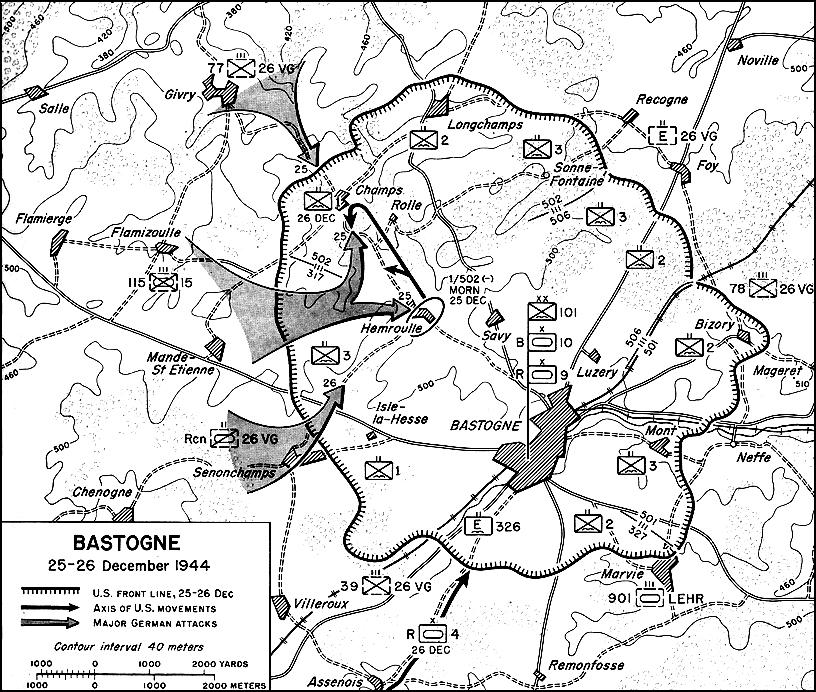
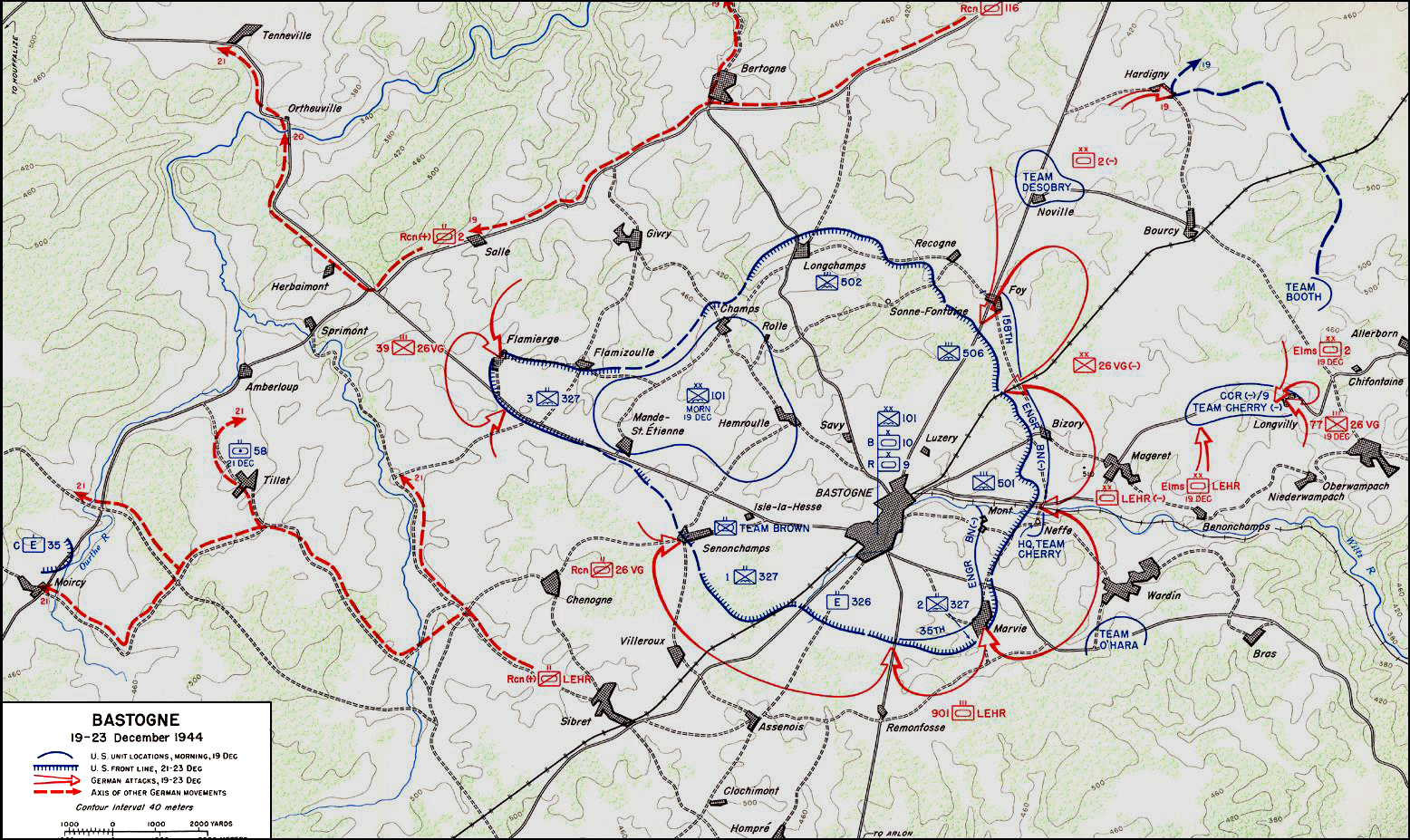
Today is the anniversary of one of the most famous events of the battle, the encirclement and survival of the 101st Airborne Division and its attached units at Bastogne. (See maps here and here.)

Bastogne was key. A major road junction, as long as it was in American hands it would cripple the German advance, and if the Nazis took it their advance could have very well rolled all the way to Antwerp.

The Germans needed it, and the Americans had to hold it. Rushed to Bastogne on December 18th, 1944, they were encircled on December 20th. On December 22nd,
What may have been the biggest morale booster came with a reverse twist-the enemy "ultimatum." About noon four Germans under a white flag entered the lines of the 2d Battalion, 327th. The terms of the announcement they carried were simple: "the honorable surrender of the encircled town," this to be accomplished in two hours on threat of "annihilation" by the massed fires of the German artillery. The rest of the story has become legend: how General McAuliffe disdainfully answered "Nuts!"; and how Colonel Harper, commander of the 327th, hard pressed to translate the idiom, compromised on "Go to Hell!" The ultimatum had been signed rather ambiguously by "The German Commander," and none of the German generals then in the Bastogne sector seem to have been anxious to claim authorship.14 Lt. Col. Paul A Danahy, G-2 of the 101st, saw to it that the story was circulated-and appropriately embellished-in the daily periodic report: "The Commanding General's answer was, with a sarcastic air of humorous tolerance, emphatically negative."
Completely encircled, cut off from all reinforcements, and limited to what few supplies could be parachuted in, the American troops held on for a week, finally being reached by units of Patton's Third Army on the afternoon of December 26th.

They would remain on the front lines of the battle until late February, 1945. For their stand at Bastogne, the entire division was awarded the Presidential Unit Citation.

More can be found at this website and also here.

Wandering The Web

Brace for impact: linkfest inbound!

The Iraq War: a war without heroes. And not because there aren't any.

Victor Davis Hanson has a new piece today, "Why Not Support Democracy?"

John at Argghhh!!! found this news interesting: Syria has signed a pledge to store Iranian nukes. Or, as John put it:
That headline should read: London - Syria has signed a pledge to be targets number one through "no stone left standing upon the other" in both the US and Israeli Air Tasking Orders by agreeing to store Iranian nuclear weapons and missiles.
Is that really a good idea, Mr. Assad? Anger us enough, and we might be willing to try regime change again...

How quickly we forget: the murderer of Robert Stethem ).S. Navy diver, executed during the hijacking of TWA in 198) was released by German authorities yesterday. He was supposed to be serving a life sentence. More at Bloodspite.

John Derbyshire at The Corner refers us to this piece by The War Nerd, "The Japanese Red Army." It's one of those things where you feel you shouldn't be enjoying it - it feels wrong - but you eagerly read on anyway. Such as:
The man who tried to rouse Japan's military spirit was a writer named Yukio Mishima. A freak, no denying that, but at least he was anti-peace, pro-war-he had "moral clarity," as they say. Not your typical militarist, though-Mishima was an "avant-garde" novelist. Haven't read his books, but I'd imagine "avant-garde" means his books make no sense even in translation. He was also a flaming mariposa, gay as a Spartan bath attendant. Worked out non-stop, got very buffed (for a Japanese) and was always posing with his shirt off, trying to look Imperial, with that rising-sun flag wrapped around him, or wearing a samurai sword and headband-only he's always got that "Hi there, Sailor" expression which pretty much ruins the effect.
The rest of it is worth reading, too.

And the good guys at Argghhh!!! have been keeping busy, too. There's something for everyone: airplanes, some humor, and remembering the Battle of the Bulge (today, Bastogne), a bit of comparative history, amd remembering today's war, too. Drop by - it's always worth a visit.

Cross-posted to The Wasatch Front.

Friday, December 16, 2005

Remembering the Battle of the Bulge

Leave it to John at Argghhh! He has called to my attention that on this day, in 1944, Nazi Germany made one last grasp for victory. And they almost succeeded.

But John does it better than I - so go see his post for yourself.

The official history of the Battle of the Bulge can be found here, free and online.