Showing posts with label Jonah Goldberg. Show all posts

Monday, October 17, 2011

The Eternal Struggle Remains

In light of this reporting by Kevin Williamson, Jonah Goldberg adds this observation:

...I’ve got to say there’s something truly refreshing, even reassuring, about the all of the Marxist twaddle coming out of these protests. These Red goons, buffoons, ruffians and tatterdemalions didn’t spring forth ex nihilo. They’ve been living among us all of this time.

Both articles are worth your time.

Friday, April 09, 2010

If America Becomes as Europe, Who Fills America's Shoes?

In the egghead-o-sphere, there’s been an ongoing debate about whether America should become more like Europe. The battle lines are split almost perfectly along left-right lines ideologically. Liberals like Europe’s welfare states, unionized workforces (in and out of government), generous benefits, long vacations, etc. Conservatives like America’s economic growth, its dynamism and innovation.

From what I can tell, everyone agrees that you can’t have Europeanization without European-size governments. Hence, America’s government outlays (pre-Obama) have tended to hover around 20 percent of GDP (the average of the last 50 years), while Europe’s are often more than twice that. In France, government outlays are nearly 55 percent of GDP. In 2009, the bailout and the Obama budget sent America’s government outlays to 28 percent of GDP, but that should decline a bit over the next decade, unless Democrats have something else in mind.

To be fair, liberals insist conservatives are wrong to think that Europeanizing America will necessarily come at any significant cost. New York Times columnist and Princeton economist Paul Krugman says that, in exchange for only a tiny bit less growth, Europeans buy a whole lot of security and comfort. Economists such as Stanford’s Michael Boskin say Europeans have a standard of living about 30 percent lower than ours and are stagnating. Others note that the structural unemployment rate in Europe, particularly for young people (it’s over 20 percent in many countries), is socially devastating.

Obviously, I’m in the conservative camp. But I think the debate misses something. We can’t become Europe unless someone else is willing to become America.

Look at it this way. My seven-year-old daughter has a great lifestyle. She has all of her clothes and food bought for her. She goes on great vacations. She has plenty of leisure time. A day doesn’t go by where I don’t look at her and feel envious of how good she’s got it compared to me. But here’s the problem: If I decide to live like her, who’s going to take my place?

Europe is a free-rider. It can only afford to be Europe because we can afford to be America.

The most obvious and most cited illustration of this fact is national defense. Europe’s defense budgets have been miniscule because Europeans can count on Uncle Sam to protect them. Britain, which has the most credible military in NATO after ours, has funded its butter account with its gun account. As Mark Steyn recently noted in National Review, from 1951 to 1997 the share of British government expenditure devoted to defense fell from 24 percent to 7 percent, while the share spent on health and welfare increased from 22 percent to 53 percent. And that was before New Labour started rolling back Thatcherism. If America Europeanizes, who’s going to protect Europe? Who’s going to keep the sea lanes open? Who’s going to contain Iran — China? Okay, maybe. But then who’s going to contain China?

But that’s not the only way in which Europeans are free-riders. America invents a lot of stuff. When was the last time you used a Portuguese electronic device? How often does Europe come out with a breakthrough drug? Not often, and when they do, it’s usually because companies like Novartis and GlaxoSmithKline increasingly conduct their research here. Indeed, the top five U.S. hospitals conduct more clinical trials than all the hospitals in any other single country combined. We nearly monopolize the Nobel Prize in medicine, and we create stuff at a rate Europe hasn’t seen since da Vinci was in his workshop.

If America truly Europeanized, where would the innovations come from?

Europhiles hate this sort of talk. They say there’s no reason to expect America to lose its edge just because we have a more “compassionate” government. Americans are an innovative, economically driven people. That’s true. But so were the Europeans — once. Then they adopted the policies they have today and that liberals want us to have tomorrow.

Wednesday, May 13, 2009

Love, Loyalty, and Dogs

Jonah Goldberg, today:

Why does canine affection have to be a trick or a con? After all, according to the very same logic, I love my wife and daughter because I have strong instinctive attachments for them grounded in my genes. But even if the genetic explanation is absolutely true, it doesn’t change the fact that I love my family.

Why should it be different with dogs? It’s not as if dogs have a Terminator-like computer screen inside their heads that says “run fake-love subroutine now” when their masters come home from work. Dogs don’t pose in front of the mirror practicing their tail-wags like lines from a script so they can make it convincing. If it is true of any living thing, it is true of dogs: They are what they are. A happy dog can no more be faking his joy than a hungry lion could be faking his appetite.

Do we really want to live in a society in which love is a genetically mandated confidence game? Where will that argument take us?

Indeed, if embracing modernity means I have to accept such unlovely idiocy, count me out. I’ll be elsewhere. If you need me, just follow the sound of the barking.

Read the whole piece.

Friday, April 10, 2009

Spread the Wealth

Seen at The Corner:

What's the Big Deal? [Jonah Goldberg]

All pirates are doing is spreading the wealth around.

Friday, March 20, 2009

Culture Determines Success

Jonah Goldberg today at NRO:

This is a very old story. The founders of modern liberalism, led by Woodrow Wilson and the two Roosevelts, were quite open about their effort to adopt a more European approach to political economy. The progressive leader William Allen White said in 1911: “We were parts, one of another, in the United States and Europe. Something was welding us into one social and economic whole with local political variations. It was Stubbs in Kansas, Jaures in Paris, the Social Democrats in Germany, the Socialists in Belgium, and I should say the whole people in Holland, fighting a common cause.”

But it was FDR’s New Deal that truly aimed to “assimilate the American into the ‘European’ political experience,” according to historian Daniel Boorstin.

But suddenly, when the most unapologetically liberal president ever actually starts to make good on this long-term liberal agenda — including, perhaps, a “new New Deal” — Obama’s new New Dealers guffaw at the parochial paranoia of it all. David Brooks is surely right that the American “commercial republic” is admirably resilient to statism, but resilience isn’t immunity — as public-opinion data and Obama’s 2008 victory demonstrate.

Obama’s defenders are right that American culture is different than Europe’s. But what they seem to forget is Patrick Moynihan’s famous observation: “The central conservative truth is that it is culture, not politics, that determines the success of a society. The central liberal truth is that politics can change a culture and save it from itself.” The political aim of liberalism for a century has been to move us in a European direction.

It’s hardly crazy that conservatives would complain about Obama’s great leap “forward.”

Wednesday, November 05, 2008

Taxes: A Fair Share for All

Have to share this.

From Jonah Goldberg, over at National Review:

We almost had a really interesting conversation about taxes in the waning days of the election. Almost.

To the surprise of few, it was discovered that Barack Obama favors something called “redistributionism.”

John McCain, it was discovered, opposes it — which also surprised a lot of people. To a certain extent, the outrage from folks on the right, at times including yours truly, over Obama’s response to “Joe the Plumber” was overdone. It was, after all, Teddy Roosevelt — McCain’s hero — who introduced the progressive income tax for precisely the purpose of spreading the wealth around. The maverick’s campaign saddlebags are heavy with redistribution policies that redistribute wealth as well.

I still believe that redistribution for its own sake is little more than institutionalized covetousness. But that’s a subject for another day. What was left out of the national tax conversation was the reality of the situation: America already redistributes its wealth. A lot of it. In fact, we’re one of the most progressive countries in the world in this regard.

Now, first let me vent a peeve. Many people think “progressive” means “good,” even though something can be progressive and bad, too. When economists refer to a “progressive” income tax, they merely mean a tax rate that increases as you move up the income ladder. (Right now in the U.S., the poor pay somewhere between 0 percent and 10 percent in federal income tax. The middle class pays 15 percent to 28 percent, and the highest earners pay 33 percent or 35 percent.) But most liberals also think that the income tax is “progressive” in the same sense that fair-trade coffee and weepy acoustic-guitar college music are progressive — i.e. good and enlightened.

Either way, the U.S. tax code is a lot more progressive than you might think. A new study by the Paris-based Organization for Economic Cooperation and Development reveals that the United States “has the most progressive tax system and collects the largest share of taxes from the richest 10 percent of the population.” Our tax system is, in fact, the most “pro-poor,” according to a Tax Foundation analysis of that study, of any developed country’s save Ireland. That’s right, we’re more progressive than France and Sweden.

The bottom 40 percent of income earners receive more from the federal income tax system than they pay into it. Meanwhile, the top 10 percent pay 71 percent of all income tax, despite only earning 39 percent of our pretax income. Taxes on the top 1 percent constitute 40 percent of tax dollars.

Lower- and middle-income workers pay a lot in other forms of taxation, particularly regressive payroll and sales taxes. Indeed, that’s one reason Obama wants to offer the middle class a tax cut. I don’t like his version of it, but I think he’s right that the middle class deserves some tax relief.

But what all Americans need is tax reform. Our tax code is outrageously impenetrable. And we’ve built a system that treats the wealthy like an inexhaustible natural resource.

Experts on economic development have long noted what they sometimes call the “oil curse.” Countries with huge oil reserves become economically wealthy but democratically impoverished, because the government can fund itself without taxing the middle class. As a result, the middle class demands less accountability from government because, heck, they didn’t pay for it. (No taxation, no representation.) In the process, the people become subjects rather than citizens.

Both Obama and McCain have a tendency to see villainy as an explanation for our economic woes. Obama thinks opposing tax increases is unneighborly and selfish. McCain has a long habit of denouncing Wall Street “greed.”

One moral hazard of such attitudes is that the investor class will start applying its entrepreneurial skills to protecting its existing wealth from the tax collector rather than trying to create more wealth.

But the greater danger is that millions of Americans might believe that all that is keeping them from the good life is the tightfistedness of people doing better than them and a government unwilling to pry those wealthy fingers open. That’s a recipe for an unhealthy political culture.

A sane tax code, under any president, would be simple, clear and direct. We’re not going to give up on redistribution in the form of, say, the earned income tax credit. But it’s important that the working and middle classes feel as if government spending comes out of their wallets, too. Otherwise, the line between citizen and subject is blurred and the costs of government are seen as someone else’s problem.

Thursday, September 25, 2008

But I Don't Drink

From The Corner:

Bold, Persistent Experimentation [Jonah Goldberg]

I have concluded the best way to deal with the election roller coaster is to commit yourself to cocktail hour.

Tuesday, July 17, 2007

Your Attention Please

The G-File is back!

Hip hip...
HUZZAH!

Hip hip...
HUZZAH!

Hip hip...
HUZZAH!

That is all.

Wednesday, April 04, 2007

u have 2 c

Jonah Goldberg's got a new G-File out, and he's in rare form, dismantling the so-called "Queen of Nuts Nice," Rosie O'Donnell, and her latest inanities.
Renowned metallurgist Rosie O’Donnell proclaimed on TV last Thursday that Sept. 11, 2001, was a more significant date than most of us realized. It was, in her words, “the first time in history that fire has ever melted steel.”

This, of course, came as news to steelworkers, blacksmiths, firefighters, manufacturers of samurai swords, and other fools who hadn’t realized that steel is forged in magic furnaces using dragon breath and pixie dust.
It gets better:
Asked if the government was responsible for its collapse, she coyly replied that she didn’t know. All she knows is that it’s “impossible for a building to fall the way it fell without explosives being involved” and that, for the “first time in history, steel was melted by fire.” Wink, wink. For the record, fire can melt steel, and buildings also collapse when heat weakens steel. But that misses the point. The point is we shouldn’t have to argue with crazy people.

Regardless, it appears that not even the heat of ridicule can weaken O’Donnell’s steely resolve to make an idiot of herself.

But the point Jonah goes on to make is all too true - she shares this craziness, and yet she is still on the air.

Why is that, ABC? She's making you guys look like a bunch of idiots.

I'm sure Father Coughlin would approve, though.

Friday, January 05, 2007

Jonah Goldberg: Classical Libralism vs. Modern Liberalism

Jonah Goldberg, writing in The Corner today:
A classical liberal in the tradition of Locke would agree that government should imprison people etc. But that's a basic social contract obligation, like national defense. No conservative disagrees with this sort of understanding of the state's functions. The modern progressive liberal believes in more than negative liberty. He argues that the state must do good for people, give them things, opportunities, and even, as in the case of Hillary Clinton, John Dewey and the Great Society liberals "meaning." The state is there to do good — like a King or God-head. There are countless category errors and false assumptions to the idea that the state can play such a role or that it should in the first place. It's narcissistic because it assumes that the government has the ability to make me whole or happy and if only someone like me were in charge the government would do the right thing because I am the measure of all good things.

The problem (or a problem) as I've said before, is that the State cannot love you the way a parent or even a King can. It is a sprawling mechanism bound to make countless errors and in the process of trying to do right by one select group or individual, it will of necessity do wrong to some other group or individual. There are no policy solutions only policy trade-offs. So, if you think the State should fix the lives of group A it will — as a basic fact of economics — come at the expense of group B. Many liberals acknowledge this. They just see no problem with taking my money to do what they think God or some abstract conception of Good or Progress requires them to do. In short, liberals think they have sufficient knowledge and moral authority to either take from me things I do not want to give or to tell me how I should live my life. See, for a small recent example of where such thinking leads, Bloomberg's New York.

Wednesday, November 01, 2006

The Insolent Kerry

"Sir, the insolence of wealth will creep out."
Samuel Johnson, as related by John Derbyshire
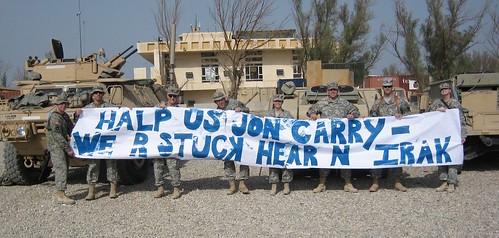
The picture
says it all, really.

Halp Us Jon Carry

But I suppose I should start with the comment that set this firestorm off:

“You know, education, if you make the most of it, you study hard, you do your homework and you make an effort to be smart, you can do well. If you don’t, you get stuck in Iraq.”
Victor Davis Hanson delivered this devastating rejoinder:

Kerry surely must be one of the saddest Democratic liabilities around. Some afterthoughts about his latest gaffe, which is one of those rare glimpses into an entire troubled ideology...

The Democrats should use this occasion to have an autopsy of Kerryism, or this strange new tony liberalism, that has turned noblisse oblige on its head. It used to be that millionaire FDRs and JFKs felt sympathy for those of the lower classes and wished to ensure that the hoi polloi had some shot at the American dream. But today's elite liberals-a Howard Dean, Al Gore, Ted Kennedy, George Soros, Ted Turner-love the high life and playact at being leftists simply because they are already insulated from the effects of their own nostrums that always come at someone poorer's expense while providing them some sort of psychological relief from guilt. Poor Harry Truman must be turning over in his grave-from bourbon, cigars, and poker to wind-surfing and L.L. Bean costume of the day says it all.
But, as usual, Jonah Goldberg had the funniest take:

Kerry Can't Apologize [Jonah Goldberg]
If you take Kerry's two statements — the written and unwritten — in their entirety, I really don't think he can apologize at this point. I really do think he could have defused this whole thing, maybe not entirely, by simply saying "I botched the joke and I'm really sorry it sounded like I was diminishing the talent and work of our troops, something I would never do. I take a back seat to no one in my respect for blah blah blah..." But now he's questioned the sanity, the integrity and the manliness of anybody who could have possibly taken him the wrong way. That means, in effect, that he's calling all these servicemen who understandably took offense at the plain meaning of his words, wusses and nutters. That makes Kerry a tool of the first order. And, if he apologizes now, with some Gilda Radneresque "never mind," it will once again reinforce his metaphysical toolishness. The guy thinks he can be president and he thinks he's doing what the "fighting Dem" base wants him to do. The problem is he has basically radiated himself with the isotope Asinine-90 and the only way the rest of his party can protect itself from radition poisoning is to sequester the guy in some lime-pit for 10,000 years until his asininity half-life deterioates to managable levels.
Posted at 9:24 AM
And John and Bill and Argghhh!!! have some more to say as well, here and here. They take it a little more personally, and for good reason.


Tyler's Take

So why all the fuss and bother?

Well, because the real John Kerry showed up. Not in the initial speech; a joke gone bad would be plausible.

It was his later statement (John at Argghhh!!! reproduces Kerry's whole speech here):
"The people who owe our troops an apology are George W. Bush and Dick Cheney who misled America into war and have given us a Katrina foreign policy that has betrayed our ideals, killed and maimed our soldiers, and widened the terrorist threat instead of defeating it."
Sen. John Kerry, D-MA, Oct. 31, 2006
That doesn't quite read like an apology to me, even though that's what the situation demanded. Kerry would have endured a little abuse, but the story would have been over.

Instead, Kerry tried to play the "vast right-wing conspiracy is out to get me" card, relying on the usual suspects to cover for him. He failed; instead, he yet again revealed his true character, and managed to make himself the biggest story of the election season, with less than a week to go. For all Kerry's supposed smarts, he's not too clever.

Since then, Mr. Kerry has made a more sincere apology (two days later), but it doesn't erase what has happened. Because the man who uttered these words is the real John Kerry, the man who would be king was the 2004 Democratic nominee for President of the United States. He deserved to lose; this is confirmation.

See, it's a little hard for us hicks here in flyover country to overcome our prejudices when you so vigorously reinforce them, Mr. Kerry.

You really are a pretentious, obnoxious, blue-blooded New England snob, a personification of the condesending rich Yankee liberal. They can keep you.

Tuesday, October 24, 2006

Seen At The Corner: Truth to Power

Jonah Goldberg, writing at The Corner:
Studio 60 [Jonah Goldberg]
No, I didn't watch it last night. I had the option of watching a squirrel groom himself, so I went with that. But I hear that Aaron Sorkin bravely spoke truth to power about the Hollywood blacklist last night. Thank God someone in the artistic community finally had the courage to tackle this taboo subject after nearly 60 years. Posted at
10:05 AM

Wednesday, August 02, 2006

Recommended Reading

Jonah Goldberg, "Lose-Lose."
The point here, alas, is that Westerners are suckers. Or, put another way, terrorists aren’t stupid. They understand that images are more important than armies. Heck, that’s why they’re terrorists in the first place...

...Terrorize your enemy and make them feel like villains in the process — that’s a powerful strategy. This strategy depends on the willing support of what Lenin called “useful idiots.” These are the accommodating Westerners — many of them intellectuals — all too willing to take the word of totalitarians and even more eager to believe that the champions of democracy are in the wrong. Some social scientists call these people “French,” but that is too limiting. For there are plenty of them in America, too.

Tuesday, May 09, 2006

By Popular Demand

Politics has a math of its own. Whereas a scientifically minded person might see things this way: One person who says 2+2=5 is an idiot; two people who think 2+2=5 are two idiots; and a million people who think 2+2=5 are a whole lot of idiots—political math works differently. Let’s work backwards: if a million people think 2+2=5, then they are not a million idiots, but a “constituency.” If they are growing in number, they are also a “movement.” And, if you were not only the first person to proclaim 2+2=5, but you were the first to persuade others, then you, my friend, are not an idiot, but a visionary.
And that's just the first paragraph.

Jonah Goldberg has written
another great G-File. It's long - and it's good.

Populism is one of those stange political forces that everyone acknowledges but then try to ignore. Politicians don't like telling people they are wrong - it costs them votes.

Goldberg's article particularly piques my interest because of a new movement to eliminate the electoral college, which I consider patently wrongheaded. The topic may sound familiar to you -
Jamo has written about it before. This movement claims that the electoral college does not reflect the "will of the people."

That it fails to represent or honor the law is immaterial. As Goldberg writes,
[Populism] does not pretend to privilege objective truth or the best arguments or even justice—if by justice you mean an objective system of judgment which might rule against “the people.” For populists, “justice” is defined by the giant baby getting its bottle.
The electoral college was not created on a whim. Rather, it is the last defense against mobocracy. It is an arbiter of sectional and regional interests, balancing regional needs and popular whimsy.

It would be nice if those so eager to change or bypass the Constitution understood it first. But popular movements often depend on ignorance - as Huey P. Long proved.


To Be Continued...

Friday, February 03, 2006

Seen At The Corner

Jonah Goldberg:

YEARNING FOR FREEDOM [Jonah Goldberg]

I'm basically on Derb's side of this argument. I don't think everyone wants freedom. Indeed, when we get around to coming up with a new metaphysic, I think we're going to need to include the fact that the human brain is wired to prefer tribal organization. All of the big "isms" of the 20th century -- communism, fascism, socialism, environmentalism, progressivism -- are predicated on a truly reactionary vision which tries to recreate tribal living on "modern" lines.Communism is a tribalism of class, fascism is tribalism of nation, Nazism is tribalism of race, Jihadism is a tribalism of religion, etc etc. Indeed, egalitarianism itself is a form of tribalism, if you ask me. It comes from the instinctive jealousy which says "no one should have more than his share of mastodon."

For all the b.s. we've heard from "revolutionaries" these last 200 years, there has been only one truly revolutionary political idea: liberalism (of the classical variety). Locke, the founding fathers, Adam Smith et al.: these were the most radical thinkers of the last 2,000 years because they tried to break the logic of tribalism. Freedom is what we have in a state of nature and it naturally terrifies us. Which is why we like to live in the tribal arrangements we evolved in. Liberty, on the other hand, is a human invention requiring civic education and commitment to certain enduring principles. It takes work precisely because it doesn't come naturally.

Thursday, October 27, 2005

A Brief History Of Conservatism

Check out Jonah Goldberg's piece on William Buckley and American conservatism in the twentieth century.

I consider myself a conservative - and it's an interesting pedigree to read. One should know the roots of one's beliefs.

Wednesday, September 14, 2005

European Anti-Americanism Isn't New

Jonah Goldberg, writing in National Review Online:
Here's a gloomy thought for you: America is going to be lonely for a very long time. After reading the October issue of The American Enterprise, "Red America, Blue Europe," that's the only conclusion one can draw.

There is a grand myth that the world, particularly Europe, loved America before George W. Bush came into office. The reality is that it only dislikes us a bit more than it used to.
Clinton wasn't popular with most of them either. They hated Bush before they even knew him.
In the 1980s, anti-Americanism was also a big problem, but fortunately the elites of Europe generally understood — with some lamentable exceptions — it was better to have America as a friend than the Soviet Union as a ruler.

But now that the Cold War is over, European elites have been liberated from the need to play well with the United States. Elections in Germany and France have largely been won in recent years by running against America. The U.S. is the only superpower and European elites don't think anyone but them should be superpowers. The Chinese have a similar attitude, of course, and pretty much every foreign policy article and expert I can find says we're going to be playing Cold War-style games with China for the next 50 years.

In other words, we are facing at minimum two enormous problems that will far, far outlast the Bush presidency, and, unlike in the past, it's not entirely clear we can rely on our friends to stand with us. This is a broad generalization, which means that it's open to contradiction by a great many facts while still, I think, remaining true. We do have some real friends, most notably Britain, Japan and Australia.
I'm not sure how much they like us either. Especially Britain.

But check this out:
A third of Germans under 30 think America ordered the 9/11 attacks. The "theory" that the Pentagon attack was self-inflicted stagecraft is in wide circulation in France, and the subject of a best-selling book.
How does one explain this? Blind hatred? Ignorance?

The rest of the article is worth reading. Mr.
Goldberg recounts that assuming we can improve ties, the benefit will be meager - most of Europe's militaries are in worse shape than at any time in the last fifty years. Aside from Britain and possibly France, none could provide significant military aid in the event of a crisis. The American-held shield of NATO has allowed them to divert defense funds into ever-bolder social engineering.

It causes me to wonder, though. Americans aren't quite as stupid as their leaders and others would believe. We're aware we aren't too popular right now. So if push came to shove, would we help out Europe again? That depends on a lot of unknowns of course; much could change. But if a Cauldron or Red Storm Rising scenario were to occur now, would Americans care to help?

Ten years ago, I'd say yes, unquestionably. I'd still say yes now - but I'm not as sure as I once was.

Wednesday, September 07, 2005

Hurricane Katrina - Blame Game

While the usual suspects try to blame Bush for everything that went wrong (I guess Halliburton must have moved up the schedule on weather control), what is becoming evident is that New Orleans was not ready - and her leaders especially were not ready.

When the smoke clears, and we're able to take a breath, we can step back and take a nice cold, clear look. But since blame is being flung in all directions, I'm going share a few of my impressions.
First of all, the scale of this disaster needs to be factored in. Katrina was a big Category 4 storm; big both in terms of strength and in terms of physical size. This was going to be a tough storm to respond to, regardless of where it ultimately struck. That's not to say there aren't lessons to be learned, but it would be well to keep that in mind. This was a massive, and quick disaster.


Also keep in mind: New Orleans' levees failed 18-24 hours after the hurricane hit. So one could look at this as two seperate major disasters, occuring at the same time. We may want to reconsider our disaster planning to take this into account.

The Federal Emergency Management Agency is taking a lot of blame right now. There's a couple of things I would like to know: did the later failure of New Orleans' levees affect the response in any way? In other words - did FEMA get caught moving the wrong way, moving material and men to Mississippi and Alabama only to learn they would be needed in New Orleans? And where (and what) did FEMA pre-position to respond?

Yes, pre-position. That's why FEMA wasn't in the Superdome right away. See, FEMA is a response organization, and not even a first-response organization. FEMA coordinates the federal response, providing assets and manpower to assist (and, if necessary, relieve) local first responders (city and state personnel, plus local volunteers). If those assets are placed inside the hurricane strike zone, they'll need to rescue themselves before they can help anyone else. See John at
Argghhh!!! for a succinct explanation of this. (Interestingly enough, his biggest problem with the federal response is a lack of information and visible leadership. He has some great info on the military response.) John also makes this exellent point: "...I would caveat that no government is perfect, is ever gonna be, and we'll fix a lot that went wrong here...and in 30 years, if it hasn't gone wrong on this scale again, we'll have trended back, because we'll want o spend the money on other things...which doesn't mean we don't try, it just means I'm a pessimist."

The state government of Louisiana and its response needs some close scrutiny. The fact that Mississippi has held together relatively well while southern Lousiana has not suggests that some major mistakes were made, and compounded upon by later mistakes.

The first response to any disaster occurs at the city, county and state level. Deploymnt of local police, fire, and state police can occur almost immediately; and National Guardsmen (once mobilized) and other state resources can be deployed faster than federal troops can be transported in and deployed. That doesn't even factor in the legal ramifications of the federal response; whereas the governor has the authority to deploy and respond immediately. But some of the first National Guard deployments occurred not in New Orleans but in Baton Rouge.

The New Orleans city government needs some close examination, too. Why did the evacuation take so long to begin? That was the mayor's call. Why weren't city buses used to transport evacuees, or at least relocated so they could be used afterwards? Was the city's emergency plan even implemented? And why did the city's police department come apart?

New Orleans' police force is down to one-third its pre-storm strength (approx. 500 now, down from 1500). From a
Defense Department briefing:
Q: General, you mentioned a disintegration of the New Orleans Police Department. Do you know how many officers are still on duty?

GEN. BLUM: I would rather not say. I think you'd be better to refer that question to the mayor of New Orleans. I have my own estimate. I would say they are significantly degraded and they have less than one-third of their original capability.
That's right - most of the police force quit, right when their city needed them most. We can argue over their motives, but I think we can generally agree that they lack the level of professionalism displayed by New York City's police force during 9/11.

One more factor needs to be taken into account - how ready was New Orleans' population? Most of the city's population did get themselves out. And sadly, if the news is to be believed, the people in the shelters did little to help themselves. Again we can argue over the whys and wherefores - but were all of those people completely incompetent? Why couldn't they organize? (Did they, and we haven't heard about it?) It seems like those at the shelters just sat there and waited for someone else to come save them.

It is becoming increasingly clear that New Orleans and Lousiana had a plan, and chose to throw it away and wing it, instead. The plan might not have been perfect - no plan is - but when you have a category 5 hurricane bearing down on you is not a time to improvise. They waited too long to order an evacuation and did not use the resources they did have to help that evacuation. Then
there is this tidbit:
In the face of a catastrophic Hurricane Katrina, a mandatory evacuation was ordered Sunday for New Orleans by Mayor Ray Nagin.

The mayor called the order unprecedented and said anyone who could leave the city should. He exempted hotels from the evacuation order because airlines had already cancelled all flights.

Gov. Kathleen Blanco, standing beside the mayor at a news conference, said President Bush called and personally appealed for a mandatory evacuation for the low-lying city, which is prone to flooding.
Question: why would the President need to call you and urge an evacuation? Shouldn't they have been able to figure that out?

There is one most significant lesson to draw from this: in the event of a major disaster; the only help you will have for some time is what you yourself can provide. Be Prepared. Too long has our civil defense ignored individual preparation - that needs to change. Everyone needs to be prepared to survive 72 hours without outside aid, and have stores of food and water sufficient for at least a week. And that is an individual responsibility.

For another, more cohesive reponse to some of the criticism, I present
Jim Geraghty at National Review (quoted in its entirety):

September 07, 2005, 8:26 a.m.
We Failed You? Try Again.
Anne Rice blames America, not local officials.

"To my country I want to say this: During this crisis you failed us. You looked down on us; you dismissed our victims; you dismissed us. You want our Jazz Fest, you want our Mardi Gras, you want our cooking and our music. Then when you saw us in real trouble, when you saw a tiny minority preying on the weak among us, you called us "Sin City," and turned your backs.” — novelist and New Orleans resident Anne Rice

Let me get this straight.

Ms. Rice, you live in (what was) a very attractive city which lies below sea level. On one side you have a giant lake; on the other side you have the Gulf of Mexico. Running through the middle is the Mississippi River. All of which are above you.

Preventing those giant bodies of water from flooding and drowning you are levees. These levees are described as “century-old.” People have been warning about the devastating effects of a direct hit from a hurricane for decades.

I’ve heard a great deal of complaint in recent days that the federal government may not have allocated enough money to speed up the upgrades to those levees. This does, however, raise the question of why city and state residents were waiting around for the federal government to send enough money to upgrade this, instead of paying for it themselves. I mean, it was only your homes, businesses, and lives at stake. Perhaps these upgrades would have been expensive. If only this city had some sort of
events to attract tourists, from which to collect taxes.

Anyway, your state and local officials decided to spend your tax dollars on something else that they (and presumably you) found more important, and then they waited for the rest of the country to pay for these life-preserving necessities.

Your beloved city and region has a colorful political history, in which there is, oh, a wee bit of corruption. I’m from New Jersey, so I can’t throw stones at that glass house. But you guys have managed to pick leaders who give you the worst of both worlds — they’re scandal ridden and incompetent in a crisis. Look, Rudy Giuliani might have run around with Judith Nathan before his divorce, but he was a hell of a leader in our darkest hours. You know the National Review crowd isn’t a fan of Pataki, but the man was a rock after 9/11 compared to Governor Weepy I’ll-Evacuate-Eventually and Mayor It’s-Everybody’s-Fault-Except-Mine. Nobody’s throwing around the adjective “Churchillian” about any of your officials these days. We didn’t pick your local officials; you guys did.

Rice asks, “how many times did Gov. Kathleen Blanco have to say that the situation was desperate? How many times did Mayor Ray Nagin have to call for aid?”

Ahem.
What about those buses left unused, less than a mile from the Superdome? JunkYardBlog notes that it’s written in the Southeast Louisiana Evacuation Plan that buses are supposed to be used for evacuation of those who don’t have personal vehicles. As JYB observes, “there is something very peculiar about a city and a state that have a plan on the books for years that outlines what to do when a hurricane is about to strike, yet when a hurricane comes roaring in, the responsible officials just chuck the plan and try winging it. Delaying and then winging it in the face of a monstrous Cat 4/5 hurricane is never, ever a good idea, especially for New Orleans.” (See more here.) Ironically, Nagin told CNN, “I need buses, man,” when he had plenty sitting around unused before the storm hit. Now they’re flooded and useless.

But it’s not like state and local officials could have seen this coming. They have never had a hurricane bearing down on them before and… oh, wait, there was Hurricane Ivan just last year. And after that dodged bullet, Blanco and Nagin both acknowledged they needed a better evacuation plan.

I would note that we’ve seen some pretty intense disasters in other parts of the country, like planes crashing into skyscrapers and subsequently collapsing, earthquakes, tornadoes, blizzards, and yet somehow, none of these disasters had the total breakdown of law and order, civil society, etc. Jonah Goldberg’s early joke about a Mad-Max style post-apocalyptic tribal anarchy may have been in poor taste, but it has turned out to be nightmarishly prescient.

We failed you? No, oh brilliant creator of Exit to Eden, you failed. You might not think of it this way, but: Your leaders failed to upgrade the levees. You elected a bunch of weepers and blame-shifters who lost their head in a crisis.

Over the past decades, your elected officials have let a criminal element incubate and grow until they ruled the streets, instead of the forces of law and order. In pop culture, a New Orleans thief is always a charming rogue with a devilish smile. In reality, they’re a bunch of thugs.

If the number of residents who are looting thugs were such a “tiny minority,” we wouldn’t have seen this widespread, relentless anarchy. Madam, a noticeable number of your neighbors saw this disaster as an opportunity to smash a window and run away with a television, an act that reveals much about the inadequacies of the local school system, since that thief won’t be enjoying that television with any electricity anytime soon.

I would also note that this is one hell of a police force your local officials hired and that you and your neighbors tolerated.
50 percent turned in their badges during the crisis and quit. Your police superintendent is conceding that some cops were looting. Just want to refresh your memory — four years ago, New York and Washington, planes falling out of the sky, thousands dead, no idea what the hell is coming next… and the cops, among others, showed up to work.

To save you guys now, I — and a lot of other Americans — will pitch in. We are witnessing the biggest mobilization of civilian and military rescue and relief crews in history. But I have a sneaking suspicion you’re going to want the rest of us to pay for the rebuilding of your city. (In the near future, we’re going to have to have a little chat about the wisdom of building below sea level, directly next to large bodies of water.) And if you’re going to come to the rest of us hat in hand, demanding the rest of us clean up after your poor judgment, I’d appreciate a little less “you failed us” and a little more “we’ve learned our lesson.”

— Jim Geraghty is reporting from Ankara, Turkey, where the locals keep asking him how something like this could happen in America.