 December 8th, 1941
Address of President Franklin D. Roosevelt to a Joint Session of Congress
Mr. Vice President, Mr. Speaker, Members of the Senate, and of the House of Representatives:
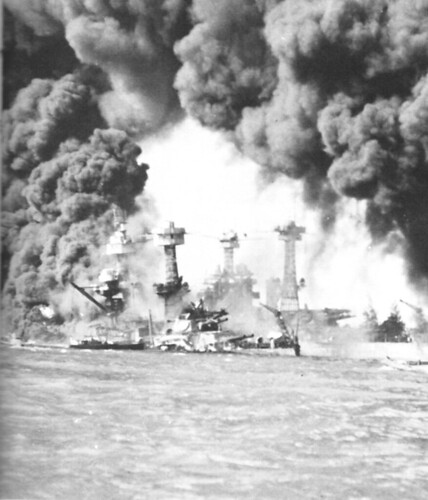
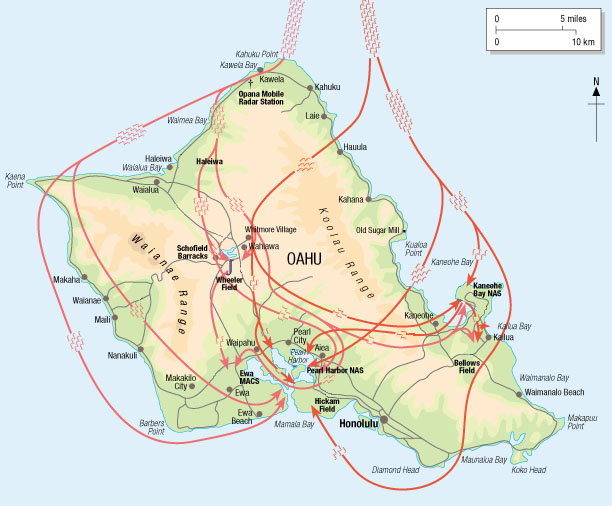
Yesterday, December 7th, 1941 -- a date which will live in infamy -- the United States of America was suddenly and deliberately attacked by naval and air forces of the Empire of Japan.
The United States was at peace with that nation and, at the solicitation of Japan, was still in conversation with its government and its emperor looking toward the maintenance of peace in the Pacific.
Indeed, one hour after Japanese air squadrons had commenced bombing in the American island of Oahu, the Japanese ambassador to the United States and his colleague delivered to our Secretary of State a formal reply to a recent American message. And while this reply stated that it seemed useless to continue the existing diplomatic negotiations, it contained no threat or hint of war or of armed attack.
It will be recorded that the distance of Hawaii from Japan makes it obvious that the attack was deliberately planned many days or even weeks ago. During the intervening time, the Japanese government has deliberately sought to deceive the United States by false statements and expressions of hope for continued peace.
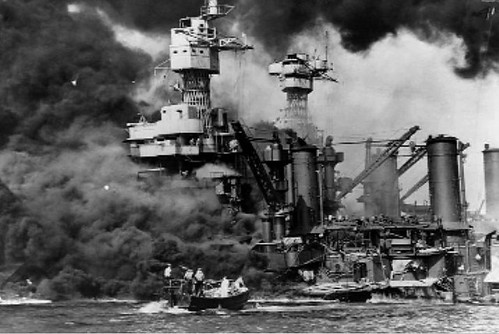
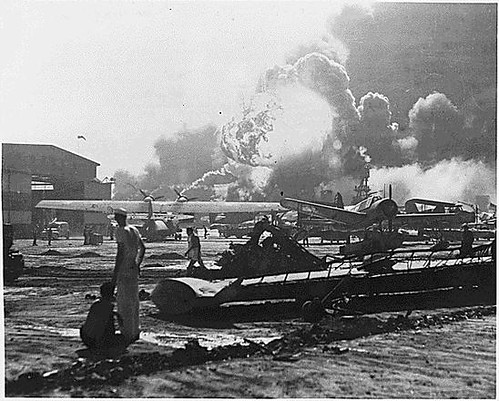
The attack yesterday on the Hawaiian islands has caused severe damage to American naval and military forces. I regret to tell you that very many American lives have been lost. In addition, American ships have been reported torpedoed on the high seas between San Francisco and Honolulu.
Yesterday, the Japanese government also launched an attack against Malaya.
Last night, Japanese forces attacked Hong Kong.
Last night, Japanese forces attacked Guam.
Last night, Japanese forces attacked the Philippine Islands.
Last night, the Japanese attacked Wake Island.
And this morning, the Japanese attacked Midway Island.
Japan has, therefore, undertaken a surprise offensive extending throughout the Pacific area. The facts of yesterday and today speak for themselves. The people of the United States have already formed their opinions and well understand the implications to the very life and safety of our nation.
As commander in chief of the Army and Navy, I have directed that all measures be taken for our defense. But always will our whole nation remember the character of the onslaught against us.
No matter how long it may take us to overcome this premeditated invasion, the American people in their righteous might will win through to absolute victory.
I believe that I interpret the will of the Congress and of the people when I assert that we will not only defend ourselves to the uttermost, but will make it very certain that this form of treachery shall never again endanger us.
Hostilities exist. There is no blinking at the fact that our people, our territory, and our interests are in grave danger.
With confidence in our armed forces, with the unbounding determination of our people, we will gain the inevitable triumph -- so help us God.
I ask that the Congress declare that since the unprovoked and dastardly attack by Japan on Sunday, December 7th, 1941, a state of war has existed between the United States and the Japanese empire.
(From American Rhetoric. An mp3 of the speech is available there.)
 For more information:
USS Arizona Memorial
National Geographic's Remembering Pearl Harbor
U.S. Navy
Eyewitness to History
Consolidated Aircraft
Hyperwar
Argghhh!
 Remembering Pearl Harbor
Deep in the American subconscious, particularly among our military planners, there lies an unspoken fear - a fear of failure, of a second Pearl Harbor which would once again leave America defenseless at the very moment when her offensive striking power could best be used to make difference. This fear drove American military planning and policy throughout the Cold War.
When the bombs stopped falling on Pearl Harbor, American naval might was so much scrap, sitting in the bottom of the harbor. The only capital ships left in the Pacific were cruisers and the untested aircraft carriers. The pride of the Pacific Fleet was gone, and with them was America's ability to respond to the flood tide offensive Japan mounted across the Western Pacific.
The next several months would be desperate. One by one, Allied
stations throughout the Western Pacific fell.
British and Commonwealth forces were hard-pressed, and eventually driven back to the peripheries of the Pacific, to India, Australia, and New Guinea.
American outposts in fought hard, but cut off from all outside support, all eventually fell. American marines and civilians fought hard at Wake, but outgunned, outnumbered, and out of ammunition, surrendered just before Christmas.
In the Philipines, American and Filipino forces lasted until the middle of March, 1942. At no time since before the outbreak of the war did those forces recieve large
amounts of supplies, reinforcements, or even hope. Still they held on. A few were evacuated by submarine and plane to Australia, but many died there, either from combat or in harsh Japanese captivity. A third of those whon survived combat
died in Japanese captivity.
Eventually, American industrial and economic might prevailed. By the end of the war, the American navy had grown to eclipse the Royal Navy in both size and might, with dozens of aircraft carriers and battleships, and with the most advanced combat aircraft in the world. American troops numbered in the millions, and American high command prepared to invade Japan itself as American heavy bombers took the war to the Japanese homeland. Ultimately American technology ended the war with the creation and use of the atomic bomb.
But that took years. There were seven desperate months, between the bombing of Pearl Harbor and the first major victory at Midway, where the Allies were rolled back wherever they fought. American combat power was incredibly weakened, and the American victory at Midway was due not so much to to skill as to desperation - America had to give battle with
what she had.
Looking back from a safe and victorious perspective some sixty years later, we forget that the Second World War was much closer than we realized. Had America been persuaded to quit early, as the Japanese strategy intended, the world would have been a drastically different - and worse - place.
There's something to be said for being stubborn, persistent, and uncompromising.


